


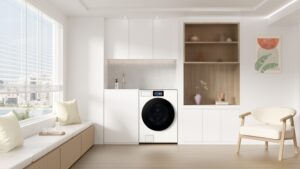
Samsung Electronics Co., Ltd. has announced that the carbon reduction impact of its AI Energy Mode in select washing machines has been officially verified by Carbon Trust Assurance. The verification was conducted under the Decarbonising the Use-Phase of Connected Devices (DUCD) specification, marking the first time any product or feature has been validated using this global framework. The milestone is particularly significant as it confirms, through independent third-party assessment, the greenhouse gas (GHG) reductions achieved during real-world consumer use rather than during manufacturing.
The verification focuses on Samsung’s AI Energy Mode, which must be activated through SmartThings Energy within the SmartThings app on compatible Android and iOS devices. A Wi-Fi connection and a Samsung account are required to enable the feature. By validating emissions reductions during the actual use phase, the assessment highlights the tangible environmental benefits delivered when consumers actively use Samsung’s connected energy-saving technologies.
“At Samsung, we continue to design our products and services with environmental considerations at the forefront,” said Jeong Seung Moon, Executive Vice President and Head of the R&D Team for Digital Appliances (DA) Business at Samsung Electronics. “AI Energy Mode is a key example of these efforts. With this verification recognising its real-world effectiveness, we will continue to enhance our products, features and services to reduce environmental impact during everyday use further.”
Samsung’s Longstanding Commitment to Carbon Reduction
Samsung has long worked to develop objective and systematic methods for assessing and managing carbon emissions generated by home appliances. As part of this commitment, the company joined the DUCD initiative as a Secretariat member in September 2022.
Led by the Carbon Trust, a global climate consultancy, the DUCD initiative brings together businesses, governments and financial institutions to advance climate action. Its goal is to standardise how energy consumption and savings from connected devices are measured, while helping establish global methodologies for calculating carbon savings from Wi-Fi–connected products.
In November 2024, the DUCD initiative published a global specification that introduced unified measurement criteria and reduction methodologies for connected devices. Unlike traditional approaches that focus primarily on emissions from production, this framework measures carbon reductions achieved during the consumer’s actual usage phase, offering a more accurate reflection of real-world impact.

Verified Carbon Reduction Through AI Energy Mode
Using the DUCD specification, Carbon Trust Assurance Ltd conducted a pilot assessment across Samsung’s global lineup of energy-efficient washing machines. The evaluation compared carbon emissions from July 2024 to June 2025 when AI Energy Mode was enabled versus when it was not in use.
According to the verification, select Samsung washing machines connected to the SmartThings platform recorded total energy consumption of 12.28 GWh during the assessment period, resulting in 5,266 tCO₂e of emissions. Of this, verified energy savings of 5.02 GWh and greenhouse gas reductions totalling 2,084 tCO₂e were directly attributed to the activation of AI Energy Mode.
The level of energy saved is equivalent to the amount of electricity used by approximately 169,000 households in a single day, based on average daily residential electricity consumption figures in the United States.
The verification applies to Samsung washing machines with the highest energy efficiency ratings in their respective markets, including Energy Star in the U.S., Grade 1 in Korea and A-rated models in the EU. All assessed devices had been connected to AI Energy Mode at least once during the evaluation period.
Looking ahead, Samsung will continue to expand its sustainability initiatives and showcase its latest energy-saving solutions and innovations at CES 2026, reinforcing its commitment to smarter, more sustainable connected living.
To learn more about Samsung products, click here.