


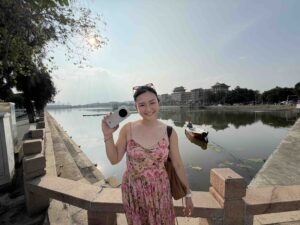
Travelling is often about discovering new places, but this trip to Fujian felt more personal. Being of Fujian descent, I’ve always known this region as the place my ancestors once called home before migrating to Singapore. Visiting Xiamen, Putian, and Fuzhou wasn’t just another holiday; it felt like reconnecting with part of my roots.
To capture the journey, I relied entirely on the Xiaomi 17 Ultra. Instead of carrying a dedicated camera, this became my all-in-one travel companion across coastlines, ancient streets, and city nights.
Powered by the Snapdragon 8 Elite Gen 5, the phone handled everything effortlessly, switching between photography, video, navigation, and editing without slowdowns. The 6000mAh battery easily lasted full days of heavy shooting, while the 6.9-inch LTPO OLED display (up to 3500 nits) made outdoor framing and review clear even under harsh sunlight.
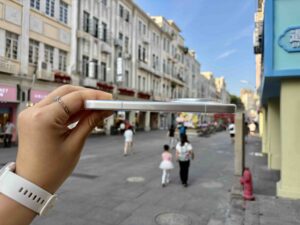
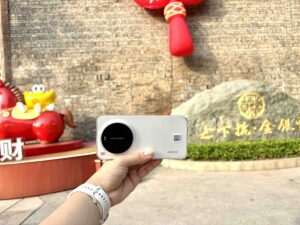
At just 8.29mm thin, the Xiaomi 17 Ultra is Xiaomi’s thinnest Ultra device yet, making it easy to carry throughout long travel days. At its core, the Xiaomi 17 Ultra felt less like a phone and more like a compact imaging system built for travel.
Xiamen: Coastlines, Islands, and City Contrast
Xiamen offered the most variety, from beaches and islands to creative districts and modern malls.
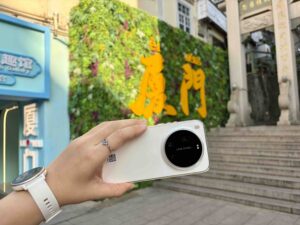
Huandao Road
Cycling along Huandao Road (观音山沙滩 to 黄厝沙滩) was where the phone’s ultra-wide camera (14mm, 115° FOV) stood out. It captured the full sweep of sea, sky, and coastline without distortion, making it ideal for landscape shots on the move.
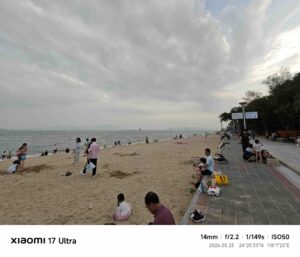
Harsh midday light was handled well by LOFIC HDR, balancing sky highlights and ocean reflections while preserving shadow detail. During golden hour, the 1-inch main sensor with f/1.67 aperture produced natural depth and warm tones, giving photos a strong sense of atmosphere.
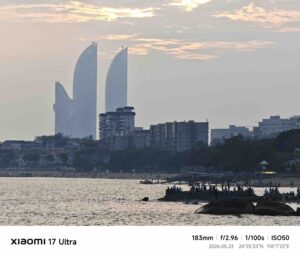
For distant subjects, the 200MP Leica periscope telephoto (75–100mm optical zoom, up to ~400mm reach) allowed clean compression of cyclists, shoreline layers, and city silhouettes far in the distance.
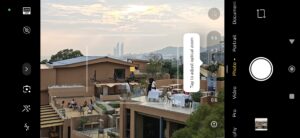
With the Xiaomi ProCut feature, the phone was able to automatically suggest the best crops from your photos, reframing scenes into cleaner compositions (like portraits or landscapes) so you can quickly get more share-ready shots without manual editing. Too easy!
Gulangyu Island
Gulangyu Island (鼓浪屿) offered a completely different pace, no cars, narrow lanes, colonial buildings, and quiet cafés hidden between winding streets.
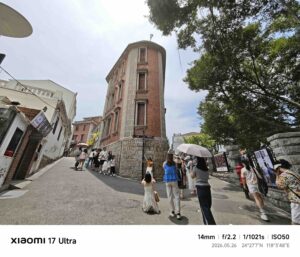
Here, the Xiaomi 17 Ultra’s Leica colour tuning and HDR system made the biggest difference. It handled the strong contrast between sunlight and shaded alleys smoothly, preserving texture in walls, wood, and aged architecture without overprocessing the scene.
The result felt natural, slightly cinematic, but still grounded in reality, perfect for slow, unplanned street photography.
Xiamen City Life
Xiamen’s urban side was where the camera system showed its versatility.
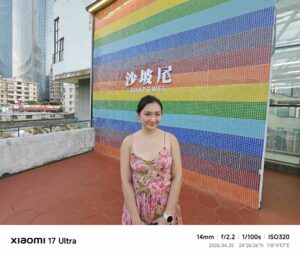
In Shapowei Art Zone (沙坡尾艺术区), constant lighting changes tested the phone’s real-time HDR and fast autofocus, which kept street shots sharp even in fast-moving, high-contrast environments.

A standout location was DVLN Park, a rooftop industrial space overlooking the city. Here, the 200MP telephoto lens created strong layered compression of rooftops and roads, while the ultra-wide lens captured the openness and scale of the space. It was also one of the best spots for experimenting with cinematic framing.
Video played a big role throughout Xiamen, too. 4K 120fps Dolby Vision recording with the strongest stabilisation made even casual walking clips smooth and cinematic without needing extra gear.
Fujian Tulou: 四菜一汤
The Fujian Tulou cluster (四菜一汤) was one of the most visually striking stops. From above, the circular earthen buildings form a unique geometric layout surrounded by greenery.
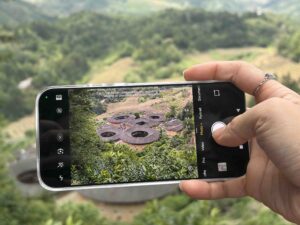
This is where the ultra-wide lens (14mm) became essential. It captured the entire scale of the Tulou complex in a single frame while maintaining natural proportions and edge sharpness.
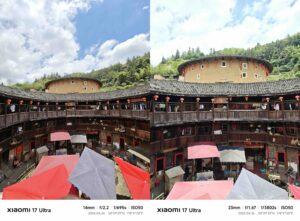
Even with challenging lighting, HDR balances preserved texture in the earthen walls while keeping skies and landscapes properly exposed, resulting in a grounded, documentary-style look.
Xiamen on a Plate
Food photography was a strong point throughout Xiamen. The Leica tuning kept dishes looking authentic rather than overly enhanced.


From Shacha noodles, oyster omelettes, peanut soup, and fresh seafood, the camera preserved natural textures, steam, and shine, especially in mixed restaurant lighting and night market environments like Zhongshan Road.
Putian: Xinghua Ancient Street at Night
In Putian, I only explored Xinghua Ancient Street (兴化府历史文化街区), but it left a strong impression, especially at night.

Warm street lighting reflected off stone paths and wooden shopfronts, creating a soft cinematic glow. This is where the Xiaomi 17 Ultra’s night photography system (LOFIC HDR + multi-frame processing) stood out.
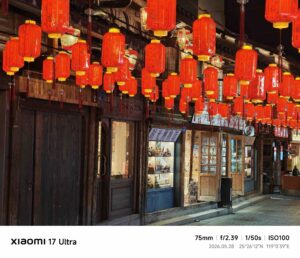
It controlled bright street lamps without blowing them out, while still preserving texture in darker alley corners.
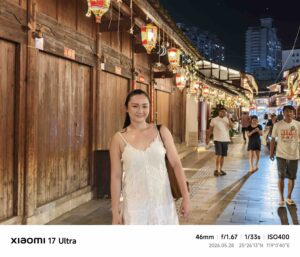
Even handheld night shots were stable thanks to OIS + EIS fusion, making it easy to capture small moments, quiet shops, reflections on stone, and passing locals, without repeated retakes.
Fuzhou: Heritage, Rivers, and Night Energy
Fuzhou felt like the most layered city, combining ancient architecture, riverfront views, and modern commercial districts. It was also where the Xiaomi 17 Ultra’s imaging system was tested across almost every scenario.

Powered by the Snapdragon 8 Elite Gen 5, the phone stayed smooth even while switching between 200MP zoom, ultra-wide landscapes, and 4K video recording during long walking days.
Sanfang Qixiang
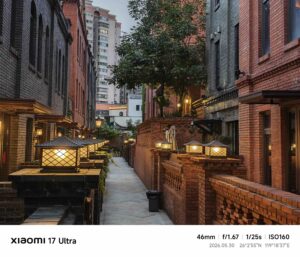
Sanfang Qixiang (三坊七巷) was full of tight alleys and wooden architecture, creating complex lighting conditions.
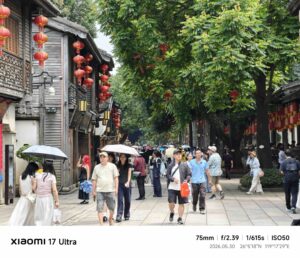
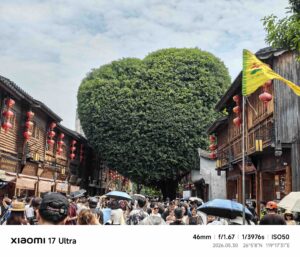
The LOFIC HDR system preserved rooftop highlights while retaining shadow detail in narrow lanes. Meanwhile, the 200MP telephoto system (75–100mm optical zoom) allowed close-up framing of doors, carvings, and street life without stepping into crowded spaces.
Riverside Views
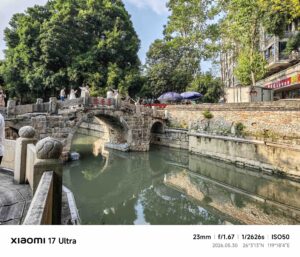
Walking through Shangxiahang (上下杭) and along the river showed a quieter side, reflections on water, lantern lighting, and historical buildings. HDR balancing helped retain highlight detail while preserving the mood.
Yantai Hill & Modern Fuzhou
At Yantai Hill (烟台山), the 200MP telephoto reach (~400mm optical-level zoom) made distant city structures and river curves clearly visible, even at long range.

Check out how far the telephoto and optical level zoom can reach with this zoomed picture of the cat. The left is at 1x.
Video, Battery & Travel Flow
Across Fuzhou, the 6000mAh battery easily supported long shooting days with navigation, photography, and video recording combined.
The ability to switch between 4K 120fps, LOG mode, and Dolby Vision video made storytelling flexible, from cinematic night streets to quick, share-ready clips, all without changing devices or workflow.
Fuzhou Food: Simple, Traditional, Honest
Fuzhou’s food scene was warm and traditional, and the Xiaomi 17 Ultra kept everything looking natural:

● Buddha Jumps Over the Wall: rich layering preserved with HDR balance
● Fish Balls: clean texture and detail in close-ups
Portraits That Feel Natural, Not Over-Processed
Portrait and selfie performance on the Xiaomi 17 Ultra felt consistently natural and travel-ready, with a strong focus on realistic skin tones and clean subject separation rather than heavy beautification. The 50MP front camera with autofocus kept selfies sharp even in motion, while Leica tuning ensured balanced, true-to-life colours across different lighting conditions.
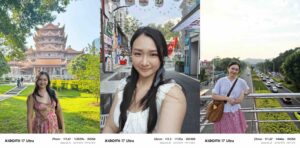
On the rear system, portraits benefited from the 1-inch main sensor (f/1.67), which naturally produced soft background blur, and even more so from the 200MP Leica telephoto lens (75–100mm optical zoom), which delivered flattering compressed perspectives ideal for travel portraits without needing to step back into crowds or traffic.
Built-In AI That Enhances How You Shoot, Edit, and Share
The Xiaomi 17 Ultra also leans heavily into AI-powered creativity and system intelligence, which quietly enhances the travel experience beyond just photography. One of the standout tools I used was the AI Video Maker, which can automatically turn a collection of clips into a short cinematic highlight video: selecting scenes, transitions, and background pacing so you don’t have to manually edit everything after a long day of shooting.
Beyond that, the phone includes a full suite of HyperAI tools across the system. In the Gallery, the AI Creativity Assistant offers features like AI Erase (removing unwanted objects or people), AI Expand (extending backgrounds beyond the frame), Ultra HD enhancement, and AI Beautify for portraits.

There’s also AI Cutout for isolating subjects, and AI Film, which helps generate stylised edits from photos and clips. On the productivity side, AI Writing tools in Notes can summarise, rewrite, or expand text, while AI Speech-to-Text and AI Translate help with real-time transcription and communication. Together, these features make the phone feel less like a capture device and more like a post-processing and storytelling assistant built directly into the system.
A Travel Companion That Disappears Into the Journey
What stood out most about the Xiaomi 17 Ultra wasn’t any single feature, but how complete it felt as a system. From ultra-wide landscapes and 200MP telephoto zoom, to LOFIC HDR night photography, Dolby Vision video, Snapdragon 8 Elite Gen 5 performance, and all-day battery life, it handled every part of the trip without interruption.
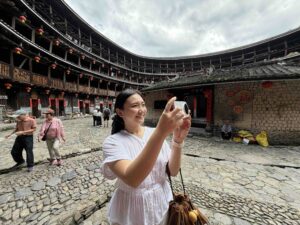
More importantly, it never felt like I was “using a camera.” I was simply experiencing Fujian, and the phone quietly made sure those moments were preserved properly.
The Xiaomi 17 Ultra is currently retailing at S$1,799 at Xiaomi Online Store as well as selected retail distributors.