




WiFi 8 hardware is beginning to arrive, and ASUS is among the first out of the gate with its new ROG Rapture GT-BN98 series, which has made its retail debut in Canada ahead of a wider global rollout in October.
For Singapore, however, there is an important distinction. Only the ROG Rapture GT-BN98 (BN25000) is slated for local availability, while the higher-end GT-BN98 Pro (BN30000) is currently a Canada-only model.
The new routers are designed not only for future WiFi 8 devices, but also to improve the networking experience with today’s hardware. ASUS says its engineering tests have shown measurable performance improvements when the GT-BN98 series is paired with existing WiFi 7 clients, giving early adopters some benefits even before WiFi 8 devices become commonplace.
WiFi 8 Focuses on More Than Raw Speed
While previous WiFi generations have often been marketed around increasingly high headline speeds, WiFi 8 is also being developed around making wireless connections more dependable in real-world environments.
ASUS highlights technologies including Unequal Modulation (UEQM) and Non-Primary Channel Access (NPCA). Its simulations indicate that these can improve connection stability and reduce the effects of interference, respectively,y once compatible client devices become available.
That could become increasingly important in homes filled with phones, computers, televisions, smart-home products and other connected devices all competing for wireless capacity.
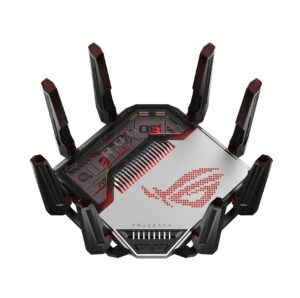
Serious Hardware for Demanding Networks
The ROG Rapture GT-BN98 series uses a quad-band WiFi 8 architecture, backed by a 2.6GHz quad-core processor and 2GB of RAM.
ASUS is offering two configurations globally: the GT-BN98 Pro (BN30000) and GT-BN98 (BN25000). The Pro can deliver total theoretical wireless throughput of up to 30,000Mbps, although ASUS notes that this maximum figure applies specifically to the BN30000 model rather than the BN25000 coming to Singapore.
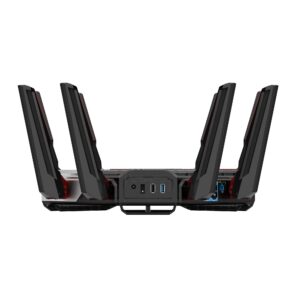
Wired networking is similarly well equipped, with two 10Gbps ports and four 2.5Gbps LAN ports. This gives users plenty of scope for connecting high-speed broadband, network-attached storage, gaming PCs and other devices without immediately running into Gigabit Ethernet bottlenecks.
ASUS has also engineered a 16-antenna architecture into eight external antennas using a 3D structural design, accompanied by an upgraded thermal system intended to maintain performance during sustained network loads.
ZenWiFi BN12 Takes WiFi 8 Around the Home
ASUS is also bringing WiFi 8 to its mesh networking range with the ZenWiFi BN12, scheduled to launch globally in October.
Described by ASUS as the first 12-stream tri-band WiFi 8 mesh system to reach the market, the BN12 is aimed at larger homes where a single router may struggle to provide consistent coverage.
ASUS claims coverage of up to 7,000 square feet, aided by what it calls 2x LDPC wall-penetration technology. Dual 10Gbps Ethernet ports also allow high-speed wired backhaul between mesh nodes, potentially reducing the performance penalty associated with wireless communication between access points.
The BN12 will include ASUS AiProtection Pro and customisable Parental Controls without a subscription fee. Support for ASUS AiMesh means it can also form part of compatible existing ASUS networking setups rather than necessarily requiring users to start again with an entirely new system.
Getting Ready for the WiFi 8 Era
The early arrival of WiFi 8 routers creates an unusual situation: the network infrastructure is reaching consumers before WiFi 8 client devices become widespread.
ASUS is positioning that as part of the appeal. The GT-BN98 is intended to work with existing WiFi devices while providing the infrastructure needed as WiFi 8-equipped phones, PCs and other hardware eventually enter the home.
Following the Canadian debut of the GT-BN98 Pro, ASUS plans to begin the worldwide rollout of its WiFi 8 routers and mesh systems in October 2026.
In Singapore, the ROG Rapture GT-BN98 (BN25000) will be the model to look out for. Local pricing has yet to be announced.
To learn more about ASUS ROG products, click here.