


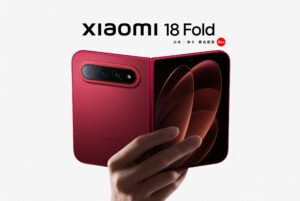
Xiaomi has officially unveiled the Xiaomi 18 Fold, its first mid-size foldable smartphone and the first Xiaomi flagship to feature the company’s latest Xiaomi XRING O3 chipset.
Alongside the new foldable, Xiaomi also introduced the Xiaomi Pad 9 Pro Max, a 13.3-inch flagship tablet designed for professional productivity and creative workloads.
The Xiaomi 18 Fold is designed to bridge the gap between a conventional smartphone and a larger foldable device. When folded, it is roughly the size of a passport, while opening it reveals a 7.58-inch tablet-like display. Despite its larger inner screen, the device weighs just 219g and measures only 5.02mm thick when unfolded.
A Foldable Designed Around a New Form Factor
Xiaomi 18 Fold uses the same 2:1 aspect ratio found on standard A4 paper, allowing the display to make better use of its available space across different types of content.
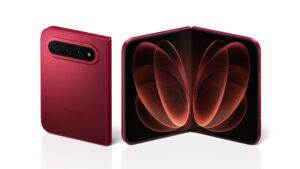
The aspect ratio is designed to work naturally with 16:9 video, 4:3 photos, documents and other content, while the inner and outer displays share the same aspect ratio to make moving between the two screens feel more seamless.
When folded, the Xiaomi 18 Fold measures 117.8 × 83.6mm and is 10.68mm thick. At 219g, it is lighter than Xiaomi’s previous foldable smartphones.
The phone also features large super-elliptical corner radii and a flat-edge frame, with Xiaomi aiming for a smoother feel in the hand. Its 5.38-inch outer display is compact enough for one-handed tasks such as pulling down menus, typing and performing back gestures.
Open it up, and the device transforms into a 7.58-inch main display housed in a body just 5.02mm thick.
Xiaomi has also optimised HyperOS specifically for the foldable form factor. Its multi-window system supports two-way split-screen layouts, while three-way split allows each section to maintain a layout closer to that of a conventional full-screen smartphone.
Built for a More Durable Foldable
Xiaomi has also focused heavily on the durability of the Xiaomi 18 Fold.
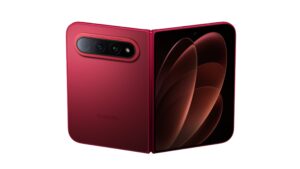
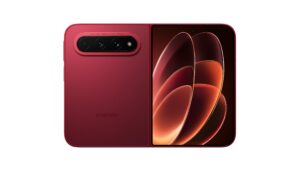
The device uses a 7000-series high-strength aluminium alloy frame, while Xiaomi Shield Glass 3.0 is used on both the outer display and rear panel. The cover glass is further strengthened through ion implantation to improve resistance against drops.
At the centre of the folding mechanism is a new-generation proprietary Xiaomi hinge featuring a patented three-link design.
The hinge wraps around the display to provide additional protection while also creating more space for the screen.
Inside, Xiaomi has introduced a new dual-layer Ultra Thin Glass (UTG) structure. This combines a 50μm upper UTG layer with a separate 30μm support layer to improve protection for the inner display.
The touch layer also replaces the previous inorganic insulating material with a more stretchable organic film, helping improve impact resistance.
According to Xiaomi, the combination of the reinforced hinge and upgraded display construction gives the Xiaomi 18 Fold 258% higher inner-display impact resistance than its predecessor and allows the device to withstand drops from up to 1.2m.
The new display stack also results in a flatter inner screen, with an average crease depth of no more than 30μm.
Xiaomi XRING O3 Brings Flagship Performance
One of the biggest changes in the Xiaomi 18 Fold is found under the hood.
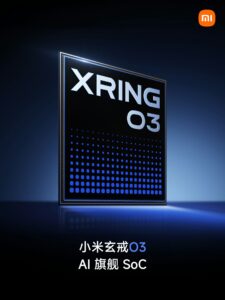
The foldable is the first Xiaomi flagship powered by the company’s Xiaomi XRING O3, its second fully in-house-designed smartphone SoC.
Built using a 3nm process, XRING O3 contains 24 billion transistors, up from 19 billion in the previous generation. It combines a 10-core all-big-core CPU with a 16-core GPU, alongside architectural-level improvements to CPU memory latency designed to improve data exchange while reducing power consumption.
The CPU consists of two Ultra cores, four Premium cores and four Pro cores. Xiaomi claims this configuration delivers 60% higher performance while using 25% less power compared with the previous generation.
Graphics are handled by the new 16-core G2-Ultra NX GPU, which delivers an 85% increase in graphics performance while reducing power consumption by 64% compared with its predecessor.
XRING O3 is also the first SoC to support LPDDR6 RAM, with data rates reaching up to 10,667Mbps and a 24-bit interface width, compared with 16-bit on LPDDR5X.
This results in memory bandwidth of up to 113.8GB/s, representing an almost 50% increase over LPDDR5X-9600.
AI Built Into the Chip
AI is another major focus of Xiaomi XRING O3.
Rather than relying exclusively on its NPU, the chip integrates AI acceleration units across multiple processing blocks. This allows lighter AI workloads to be handled without unnecessarily activating the NPU, helping improve efficiency and reduce power consumption.
The SoC features a new quad-core low-power NPU based on a SIMT architecture. Each NPU core combines a Tensor unit with two Vector units, providing up to 200 TOPS of tensor performance using A8W4 and 3.13 TFLOPS of vector performance.

When combined with Xiaomi MiMo’s proprietary five-value quantisation technology, Xiaomi claims XRING O3 can deliver 45% faster on-device decoding compared with the previous-generation flagship processor.
In everyday use, Xiaomi says the new platform brings improvements to multitasking, large-screen gaming and extended video playback, while also helping with battery life and thermal management.
Leica Triple-Camera System With 200MP Main Camera
The Xiaomi 18 Fold also gets a 200MP Leica triple-camera system.
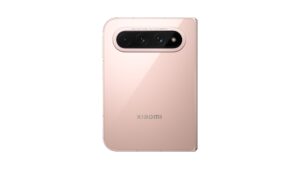
Its main camera uses a 200MP HP5 sensor measuring 1/1.56-inch, with support for native high dynamic range and in-sensor lossless zoom.
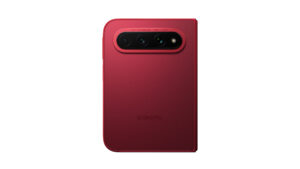
Joining it is a 50MP Leica periscope telephoto camera using an inverted design intended to reduce the size of the camera module. The camera has an 80mm focal length, making it suitable for portraits, while its in-sensor zoom can extend the focal length to 160mm with lossless zoom for greater flexibility when shooting landscapes.
Bright, High-Refresh Displays
Both the inner and outer screens on the Xiaomi 18 Fold use Xiaomi HyperRGB panels, featuring a full RGB subpixel structure that makes full use of red, green and blue subpixels.
Both displays are also Super Sunlight Displays, capable of reaching up to 4,000 nits peak brightness.
They support a 1–120Hz LTPO adaptive refresh rate, allowing the refresh rate to dynamically adjust according to what’s happening on screen while helping maintain smooth visuals and power efficiency.
The high brightness is designed to keep content visible even under direct sunlight or in brightly lit indoor environments.
6,000mAh Battery in a Thin Foldable
Despite its slim profile, Xiaomi 18 Fold packs a 6,000mAh silicon-carbon battery, which Xiaomi says is the largest capacity among foldables in the same form factor.
Both battery cells use a stacking process with 20% high silicon content, with energy density reaching up to 920Wh/L.
Charging support includes 67W wired HyperCharge and 50W wireless HyperCharge.
For connectivity, the foldable supports Xiaomi Astral Communication, offering global roaming coverage across more than 210 countries and regions through support for over 52 carriers.
It also includes Wi-Fi 7 and UWB ultra-wideband connectivity.
Ceramic Edition Adds a Different Finish
For those looking for something more distinctive, Xiaomi is also offering the Xiaomi 18 Fold in a Ceramic Edition.
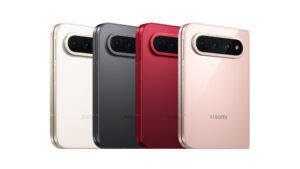
The special model uses lightweight silicon nitride ceramic for its rear panel, marking the first time Xiaomi has used the material for a smartphone back panel.
Silicon nitride is an advanced ceramic material commonly used in automotive and aircraft engines because of its high-temperature resistance.
For the Xiaomi 18 Fold, the material combines the smooth, warm feel associated with ceramic with high hardness, while weighing approximately 50% less than traditional zirconia ceramic.
Xiaomi Pad 9 Pro Max Targets Professional Productivity
Xiaomi also unveiled the Xiaomi Pad 9 Pro Max, expanding its flagship tablet lineup with a model aimed at professional productivity and creative work.
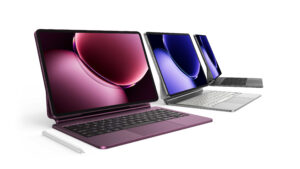
The tablet is powered by the same Xiaomi XRING O3 processor as the Xiaomi 18 Fold and runs Xiaomi HyperOS, bringing together flagship performance, AI capabilities and large-screen multitasking.
At the front is a 13.3-inch 3.4K display with a resolution of 3408 × 2272 pixels and a 144Hz refresh rate. Brightness reaches up to 1,000 nits, helping maintain visibility across different lighting conditions.
For creative professionals, the tablet supports a Professional Original Colour mode and multi-screen colour consistency, allowing more accurate and consistent colour reproduction across compatible devices.
XRING O3 Comes to Xiaomi’s Flagship Tablet
The Pad 9 Pro Max uses the same 10-core all-big-core CPU and G2-Ultra NX GPU found in the XRING O3 platform.
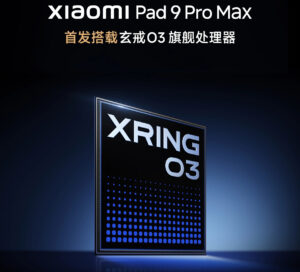
Xiaomi claims the tablet achieves an AnTuTu score of more than 5.61 million, while CPU multi-core performance is up 54% and GPU performance is up 85% compared with tablets powered by Xiaomi XRING O1.
Running on HyperOS, the tablet supports enhanced multitasking, allowing users to work across multiple applications simultaneously. Its AI features are also designed to simplify everyday tasks and improve productivity.
The large-screen tablet is powered by a 12,000mAh battery and supports 120W HyperCharge.
For audio and video conferencing, it features a six-microphone array with high signal-to-noise ratio microphones designed to capture voices more clearly from greater distances.
Connectivity includes Wi-Fi 7, while a new DP-in video input expands the tablet’s potential beyond traditional tablet use.
Through a full-featured USB-C cable, the Pad 9 Pro Max can accept video input at resolutions of up to 3.4K at 120Hz, giving users additional flexibility for work, gaming and creative applications.
Pricing and Availability
The Xiaomi 18 Fold is available in Black, White, Red and Ceramic Edition.
The standard Xiaomi 18 Fold starts at RMB 10,999 for the 12GB+256GB model, while the 12GB+512GB version is priced at RMB 11,999. The 16GB+512GB model costs RMB 12,999, while the top-end 16GB+1TB version is priced at RMB 14,999.
The Xiaomi 18 Fold Ceramic Edition is exclusive to the 16GB+1TB configuration and starts at RMB 15,999.
The Xiaomi Pad 9 Pro Max comes in Black, Silver and Red.
The tablet starts at RMB 4,799 for the 8GB+256GB model. The 12GB+256GB version costs RMB 5,299, while the 12GB+512GB model is priced at RMB 6,099. The 16GB+256GB configuration costs RMB 5,799, while the 16GB+512GB version is priced at RMB 6,599.
There is also a Matte Glass Version available in Red. The 16GB+512GB model costs RMB 6,899, while the 16GB+1TB version is priced at RMB 7,899.
There is currently no official release date or announcement for the Xiaomi 18 Fold in Singapore.