


Google Maps has become one of the most indispensable apps on our smartphones, whether we’re searching for a nearby café, navigating unfamiliar roads or planning an overseas holiday. Now, Google is giving the platform its biggest transformation in more than a decade.
Rolling out to users in Singapore, Ask Maps combines the power of Google Search, Google Maps and Gemini to create a more conversational and intelligent way to explore the world. Instead of tapping through multiple menus and filters, users can simply ask questions in natural language and receive personalised, real-time answers.
The update transforms Maps from a navigation tool into something much closer to an AI-powered travel companion.
Real-Time Information That Helps You Make Better Decisions
One of the biggest upgrades is the introduction of a new live transit board that automatically updates throughout the day.
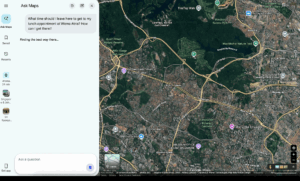
Rather than manually checking train schedules or calculating travel times, users can ask questions such as, “What time should I leave here to get to my lunch appointment at Wisma Atria at 2 pm? How can I get there?”
Ask Maps will present available transportation options at a glance, taking current conditions into account.
Drivers also benefit from more timely information. Real-time updates on traffic disruptions help users avoid congestion, while live crowd data can help determine the best time to visit popular restaurants, attractions and shopping destinations.
For anyone who has ever arrived at a fully booked restaurant or encountered unexpectedly long queues, this could be one of the most useful additions to Maps.
Finding What’s Around You Becomes Much More Natural
Traditional location searches often require users to enter specific keywords, apply filters and browse through multiple results.
Ask Maps simplifies the process by allowing users to search conversationally.
Need a late-night meal after working overtime? Simply ask, “Find the nearest halal eateries near me that are still open past 10 p.m.”
Looking for something more specific? Users can search for everything from nearby comedy performances to scenic locations for watching the sunset.
The AI also takes previous searches and reviews into account to generate more personalised recommendations, helping users discover places that better match their interests.
Travel Planning Gets an AI Assistant
Perhaps the most ambitious feature is Ask Maps’ ability to help plan entire trips.
Instead of researching attractions individually, travellers can describe their preferences and let Maps generate a suggested itinerary.
A prompt such as, “Help me plan out a route for my trip to explore some cultural sites around Istanbul starting from Hotel Amira Istanbul between 10 am and 12 pm,” allows the AI to build a curated route based on the user’s location and interests.
Real-time hotel pricing and availability are also integrated into the experience, reducing the need to jump between multiple travel websites and applications.
The result is a much more seamless travel-planning experience that combines navigation, accommodation and itinerary building within a single platform.
Conversations That Continue Where You Left Off
Another notable addition is conversation memory.
Unlike traditional searches that begin with a blank slate each time, Ask Maps can remember previous discussions and recommendations.
Users returning to an unfinished travel plan or revisiting ideas from an earlier search can continue the conversation without having to start over.
It’s a small change, but one that makes the experience feel significantly more personal and intuitive.
From Maps to Travel Companion
For years, Google Maps has been one of the world’s most popular navigation tools. With Ask Maps, Google is clearly aiming for something much broader.
By combining Search, Maps and Gemini, the company is moving beyond turn-by-turn directions and transforming Maps into an AI-powered platform that can answer questions, suggest experiences, plan journeys and remember preferences.
For Singapore users, the rollout means that finding a restaurant, planning a holiday or simply figuring out when to leave for an appointment may soon feel less like searching and more like having a conversation.
Find out more here.