


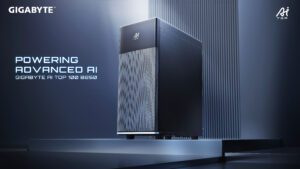
GIGABYTE is making a case for bringing more artificial intelligence workloads out of the cloud and back onto the desktop with the GIGABYTE AI TOP 100 B850, a high-performance system designed specifically for local AI development.
Announced on September 30, 2026, the new workstation targets developers, researchers and businesses that want to run large language models, generative AI, deep learning and increasingly sophisticated agentic AI applications on their own hardware.
The advantage is not simply performance. By processing models locally, organisations can maintain greater control over sensitive information, reduce dependence on cloud infrastructure and avoid some of the recurring costs associated with cloud and token-based AI services.
Ryzen 9 9950X at the Heart of the System
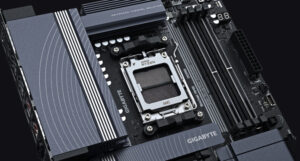
The AI TOP 100 B850 is powered by AMD’s Ryzen 9 9950X, providing 16 cores and 32 threads for demanding development and compute workloads.
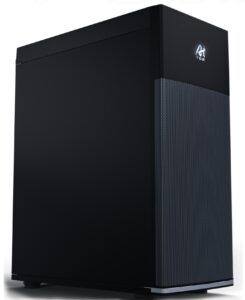
GIGABYTE pairs the processor with 128GB of DDR5 memory and a 2TB PCIe Gen4 SSD, giving developers enough working memory and storage for sizeable datasets, locally stored models and more complex development environments.
Where the system becomes particularly interesting, however, is its choice of graphics hardware.
GIGABYTE offers two configurations depending on whether the priority is faster generation or enough GPU memory to accommodate much larger AI models.
RTX 5090 Targets Faster Local AI
The first configuration features an NVIDIA GeForce RTX 5090, bringing CUDA acceleration to local LLMs, generative AI and agent-based applications.
According to GIGABYTE, the RTX 5090 configuration can achieve generation speeds of up to 64.9 tokens per second when running a 32-billion-parameter model.
That makes it the performance-oriented option for applications where response speed matters — such as locally hosted AI assistants, interactive generative tools or agentic workflows that may need to make repeated model calls while completing a task.
Running these applications locally can also be useful when data is confidential or when developers want to experiment without repeatedly sending information to an external AI service.
Dual Radeon GPUs Take On Models Up to 235 Billion Parameters
The alternative configuration takes a different approach, pairing two AMD Radeon AI PRO R9700 GPUs to provide a combined 64GB of VRAM.
Rather than focusing primarily on generation speed, the additional GPU memory dramatically increases the size of the models the machine can accommodate.
GIGABYTE says the dual-GPU configuration can perform inference on models with up to 235 billion parameters and fine-tune models containing as many as 110 billion parameters.
That potentially puts considerably larger AI experiments within reach of individual developers, research teams and smaller businesses without requiring a dedicated server room or relying entirely on rented cloud GPUs.
Built to Grow With AI Workloads
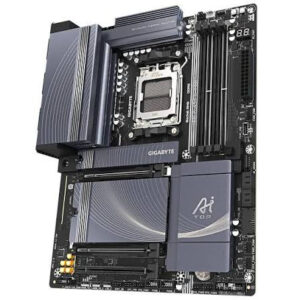
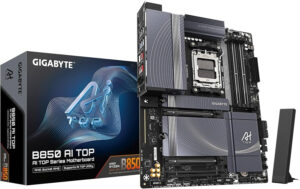
Unlike some tightly integrated AI systems, the AI TOP 100 B850 is built around standard desktop components, giving users more freedom to upgrade it as their requirements change.
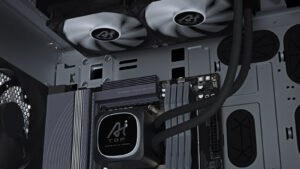
The motherboard includes dual PCIe 5.0 slots for high-performance graphics hardware, while memory and storage can also be expanded.
That could prove important given how quickly local AI requirements are evolving. A machine purchased for today’s LLM inference could later require more storage for datasets, additional memory for development workloads or different GPUs as larger models become practical to run locally.
GIGABYTE has also equipped the system with a 1,600W 80 PLUS Platinum power supply, providing the capacity required by its high-end components while leaving some headroom for future upgrades.
Designed to Keep Running Under Heavy Loads
Sustained AI processing places very different demands on a computer compared with short bursts of conventional desktop activity.
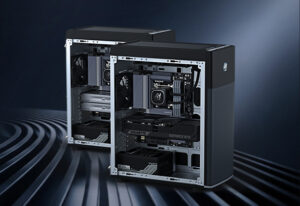
To handle those workloads, the AI TOP 100 B850 combines a purpose-built AI TOP motherboard, liquid cooling for the processor and a high-airflow chassis design.
The cooling architecture is intended to dissipate heat generated by the CPU, GPUs and other components during extended training, fine-tuning and inference sessions, helping the system maintain stable performance over longer compute cycles.
Networking is similarly geared towards professional workloads. Dual 10GbE LAN ports can accelerate movement of large datasets between the workstation, network storage and other systems, while Wi-Fi 7 provides a wireless alternative.
High-speed connectivity also includes USB 20Gbps Type-C, useful when models or datasets need to be transferred to and from external storage.
AI TOP Utility Simplifies Local Development
GIGABYTE is pairing the hardware with its AI TOP Utility, designed to make running and developing AI models locally more approachable.

The software brings system monitoring, memory offloading and dataset creation into a single interface. GIGABYTE says it can be used to simplify the training and fine-tuning of both text-based and multimodal AI models.
Memory offloading is particularly relevant for local AI, where the size of a model can quickly exceed the memory available on an individual GPU. Managing resources across the system can help developers make better use of the workstation’s available hardware.
A Different Alternative to Cloud AI
The AI TOP 100 B850 arrives as increasingly capable AI models create a choice for organisations: send workloads to powerful cloud infrastructure or invest in hardware capable of doing more of the work locally.
Cloud AI still offers enormous scalability, but a powerful deskside system can make sense for repeated experimentation, sensitive datasets and workloads where predictable infrastructure costs or direct control over data are priorities.
GIGABYTE’s dual configuration reflects the different compromises involved. The GeForce RTX 5090 model prioritises fast local generation, while the dual Radeon AI PRO R9700 version trades that emphasis for 64GB of VRAM and the ability to work with much larger models.
With a 16-core Ryzen processor, 128GB of memory, high-speed networking and an upgradeable desktop architecture around those GPUs, the GIGABYTE AI TOP 100 B850 is ultimately designed to put a substantial amount of AI computing power beside the developer rather than somewhere in the cloud.
Find out more here.