


Girard-Perregaux continues to push the boundaries of Haute Horlogerie with the unveiling of the Minute Repeater Flying Bridges, powered by the new Calibre GP9530. As the third benchmark-calibre introduced by the Manufacture in less than six months, the movement highlights the brand’s dynamic approach to watchmaking innovation while honouring a legacy dating back to the 1820s.
Entirely designed, developed and assembled in-house, Calibre GP9530 is a highly complex openworked movement comprising 475 components. It integrates two grand complications — a minute repeater and a tourbillon — with a newly developed self-winding system featuring a micro-rotor. The meticulous assembly and decoration of the calibre require nearly 440 hours of craftsmanship, underscoring the level of expertise involved in its creation.
A Modern Expression of the Minute Repeater
With the Minute Repeater Flying Bridges, Girard-Perregaux presents a fresh interpretation of one of watchmaking’s most revered complications. The minute repeater, which allows the wearer to “listen” to the time through a sequence of chimes, has long been embedded in the Manufacture’s DNA.
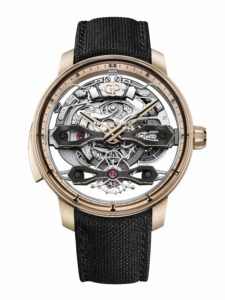
Calibre GP9530 combines centuries-old watchmaking tradition with contemporary engineering, resulting in a movement that enhances both acoustic performance and visual transparency. The openworked architecture reveals the intricacy of the mechanism while maintaining a perfectly balanced, symmetrical design.
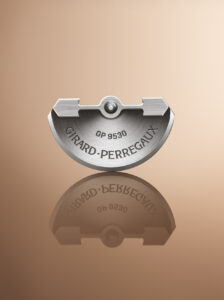
Girard-Perregaux’s master watchmakers faced a significant technical challenge in integrating two grand complications and a self-winding mechanism within a movement measuring 43.55 mm in diameter and just 10.75 mm thick. The result is a movement that not only performs at the highest level mechanically but also offers an elegant visual presentation inspired by the brand’s iconic Three Bridges architecture.
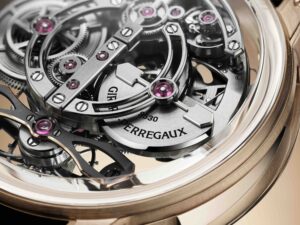
In this contemporary interpretation, the signature design is revisited with the third bridge positioned at the rear of the movement. In contrast, the arrow-shaped bridge ends reflect Girard-Perregaux’s commitment to both tradition and forward-looking design.
Chiming Watches at the Heart of the Manufacture
The tradition of chiming watches dates back to the late 18th century, when the bell attached to pocket watches was replaced by a system of gongs and hammers wrapped around the movement — the same fundamental principle used in today’s minute repeaters.
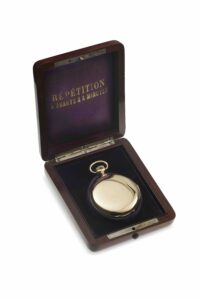
Among the pioneers of this technology was Jean-François Bautte (1772–1837), a Geneva watchmaker whose early work explored chiming mechanisms capable of repeating hours and quarters on demand. Bautte was not only a master watchmaker but also an engraver, jeweller and goldsmith. His passion for mechanics and artistry led him to create remarkable objects such as music boxes, singing birds and mechanical automatons.
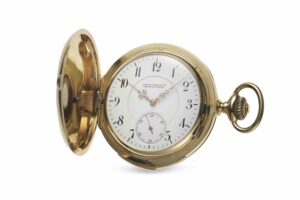
Visionary in both craftsmanship and business, Bautte also introduced an innovative production approach by bringing all watchmaking trades under one roof. This integrated system allowed him to oversee every stage of creation — from design and manufacturing to finishing — laying the foundations of the modern integrated Manufacture.
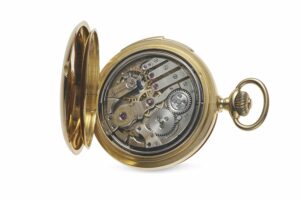
Girard-Perregaux continues to build on this legacy. Throughout the 19th century, Constant Girard-Perregaux and Constant Girard-Gallet further advanced chiming watch technology, producing alarm watches, Grande Sonnerie models and minute repeaters combined with complications such as chronographs and calendars.
In 1996, the Manufacture achieved another milestone by combining a minute repeater and tourbillon in a wristwatch. Later creations, such as the Opera I and Opera I, featured Westminster chimes reproducing the four-note melody of a carillon. These highly complex movements require multiple stages of assembly, testing and adjustment — a level of expertise possessed by only a few elite watchmaking Manufactures.
Today, the Minute Repeater Flying Bridges represents the latest chapter in this long-standing tradition.
Engineering Sound: A New Approach to Acoustic Performance
At the heart of the development of Calibre GP9530 lies a singular objective: achieving exceptional sound quality.
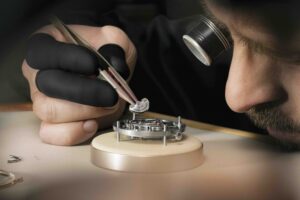
Girard-Perregaux engineers focused on optimising tone clarity, vibration transmission and case acoustics, while eliminating any unwanted mechanical noise that could compromise the purity of the chime.
Several technical innovations contribute to this acoustic performance:
● Titanium mainplate and bridges – lightweight and rigid, titanium facilitates the efficient propagation of vibrations through the movement.
● Direct connection between the mainplate and case – ensuring vibrations are transmitted without loss to the rose gold case.
● Domed sapphire crystals on both sides – enhancing resonance and amplifying the sound of the gongs.
● Single-piece gong construction – the gongs and gong stud are crafted from a single metal piece to prevent sound interference.
● Silent micro-rotor system – the jewelled white-gold micro-rotor winds the movement without introducing noise that could disrupt the chiming sequence.
● Relocated centrifugal regulator – moved to the back of the movement to preserve sound purity.
The openworked structure also plays a key role. By reducing material within the calibre, the movement allows sound waves to travel freely inside the case, producing a clear and vibrant melody.
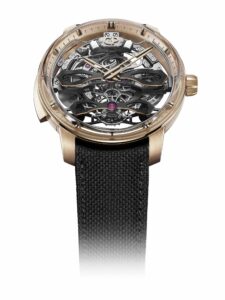
The watch is activated via a newly developed arrow-shaped slide mechanism integrated into the monobloc case middle.
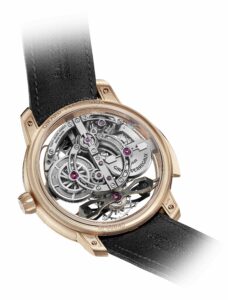
This design not only improves reliability but also provides water resistance up to 30 metres — a rare feature for such a complex chiming watch.
A New Era for Girard-Perregaux Minute Repeaters
By combining a minute repeater, tourbillon and innovative micro-rotor winding system within an openworked architecture, the Minute Repeater Flying Bridges represents a new milestone for the Manufacture.
The Girard-Perregaux Minute Repeater Flying Bridges is priced at SGD 855,100 (including tax).