


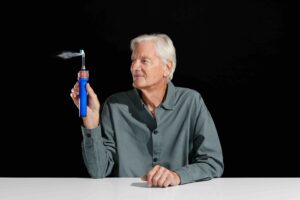
Unveiled by James Dyson in Paris on 1 September 2026, the Dyson CameraJet is designed to see, identify and target interdental spaces while you brush.
Its integrated 100,000-pixel macro-lens camera works with Dyson’s Gap Optical Targeting technology to scan the mouth in real time, identifying and predicting gaps between teeth before triggering a targeted burst of mouthrinse.
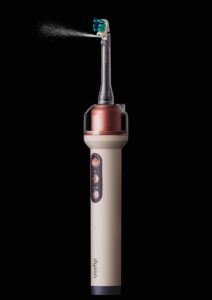
The system scans 28 live images per second, with the jet activated within 100 milliseconds of detecting a gap. Dyson says the technology is powered by a machine-learning system trained using 470,000 dental images and more than 16 million lines of code.
A toothbrush that can see where you’re brushing
The idea behind CameraJet comes from a fairly simple problem: most people don’t brush or floss as thoroughly as they should.

Dyson says that nine in 10 people do not floss as regularly as recommended, while the average person spends only around 45 seconds brushing, considerably less than the commonly recommended two minutes. The spaces between teeth are particularly easy to miss, allowing plaque to accumulate and harden over time.
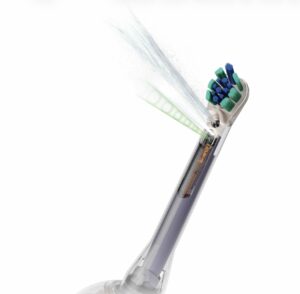
Rather than relying on users to manually identify those areas, CameraJet attempts to automate the process. Its camera continuously looks for interdental gaps and, when one is detected, directs a precision jet of mouthrinse straight at it.
A gentler approach to water flossing
The precision jet itself is another area where Dyson has taken a different approach.

Instead of the sharp, needle-like jet found in many conventional water flossers, CameraJet uses a broad conical jet designed to sweep plaque away over a wider area. Dyson says the lower-pressure design is intended to be gentler on the gums and enamel while still effectively removing plaque.
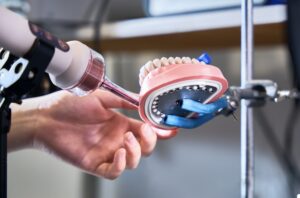
To develop the system, Dyson worked with the National University of Singapore’s Faculty of Dentistry over five years to create a proxy plaque material. This allowed its engineers to repeatedly test and refine the jet’s ability to remove plaque without requiring a clinical trial for every design iteration.
Mouthwash, built right into the brushing routine
CameraJet also incorporates mouthrinsing directly into the brushing process.

A compact 12.5ml mouthrinse tank dispenses the required amount during a cleaning session, while Dyson’s anti-gravity tank uses a diaphragm pump and pressure chamber to maintain consistent fluid delivery regardless of the toothbrush’s orientation.
That means the jet is designed to continue working even when you’re brushing the back of your teeth with the toothbrush held horizontally, something Dyson says can be an issue with conventional “straw in a cup” tank designs.
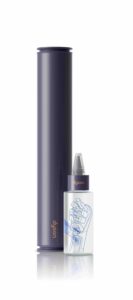
The charging dock doubles as a refill station, with Dyson claiming it can refill the toothbrush in just three seconds at the touch of a button. A travel case is also included.
Dual-bristle head and anti-stall sonic brushing
Of course, CameraJet is still a toothbrush, and Dyson has reworked the brushing mechanism too.
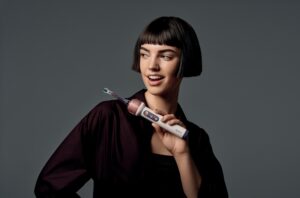
The Dual Bristle Brush Head features a contoured design intended to better follow the shape of the teeth. Firmer inner bristles focus on surface stains, while softer outer bristles are designed to clean along the gumline.
Each brush head also includes an RFID tag that tracks how many cleaning cycles it has completed and alerts users when it needs to be replaced. A sensitive version is available for users with sensitive teeth and gums.
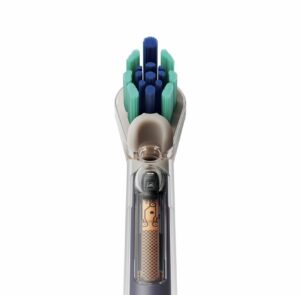
Dyson’s Variable Sonic Oscillation is designed to address another issue the company identified with conventional sonic toothbrushes: bristles can stall when pressed against the tooth.
Instead of maintaining a fixed oscillation angle, CameraJet varies the angle of movement to keep the bristles moving. Dyson says external testing found the technology removed up to 69% more plaque than leading premium electric toothbrushes in hard-to-reach areas.
A complete dental system
Dyson isn’t stopping at the hardware. CameraJet forms part of a wider Dyson Dental System, which includes specially formulated toothpaste and mouthrinse.
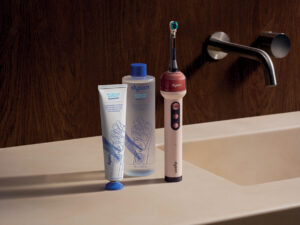
The toothpaste is non-foaming and formulated without SLS, helping minimise foam that could obstruct the camera’s view during brushing. The mouthrinse is designed specifically for use with the precision jet.
Both products contain sodium fluoride, phosphates and xylitol, while the mouthrinse also includes an antibacterial formulation intended to reduce malodour-causing bacteria and freshen breath.
The products are available in Ginger Mint and Spearmint, with a Peppermint Sensitive toothpaste also available.
Your dentist’s view, through your phone
CameraJet is also connected, with 2.4GHz Wi-Fi and Bluetooth built in.
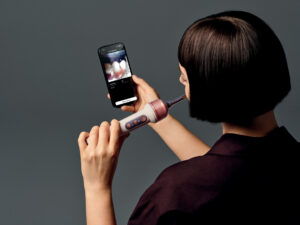
Through the MyDyson app, users can access a live view from the integrated endoscope-style camera, essentially giving them a closer look at what the toothbrush is seeing. The app also provides guided cleaning, brushing and flossing insights, coverage mapping and personalised feedback to highlight areas that may have been missed.
Privacy is also addressed: Dyson says the camera is only active during live viewing or automatic jetting, with no images recorded or stored on the toothbrush or in the cloud.
Users can also switch between automatic and manual jetting modes and adjust brushing intensity.
Price and availability in Singapore
The Dyson Dental System is priced at S$699 and became available in Singapore from 1 September 2026 at 5:30 pm SGT, with availability at Dyson stores and selected electronics retailers from 2 September onwards.
The package includes the Dyson CameraJet toothbrush, charging dock, two brush heads and Pogo cable.
Customers purchasing directly from Dyson will also receive a complimentary Starter Kit containing Dyson Toothpaste and Dyson Mouthrinse, while stocks last.
The toothbrush is available in Ceramic Pink and Ceramic Ultra Blue.