


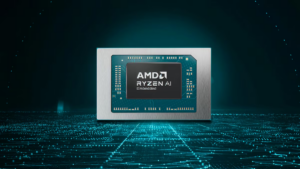
Advanced Micro Devices (AMD) has expanded its AMD Ryzen AI Embedded P100 Series processor portfolio, introducing new chips designed to deliver scalable and efficient AI computing for industrial systems and edge applications. The latest processors deliver major performance improvements while maintaining the same compact footprint, offering up to twice as many CPU cores, significantly higher GPU compute power, and an estimated 36% increase in system-level AI performance.
As industries rapidly adopt AI-driven automation, from factory robotics to medical imaging, there is growing demand for platforms capable of real-time AI processing, deterministic performance, and long-term reliability in always-on environments. AMD’s expanded lineup addresses these needs with processors built for next-generation industrial automation, mobile robotics, and intelligent edge deployments.
Scalable AI Compute for Demanding Edge Workloads
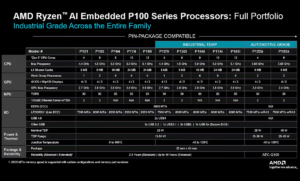
The new processors integrate eight to 12 “Zen 5” CPU cores, up to 80 system TOPS of AI acceleration, AMD RDNA 3.5 graphics for real-time visualisation, and a neural processing unit based on AMD XDNA 2 architecture for low-latency, energy-efficient AI inference. By combining CPU, GPU, and NPU capabilities on a single chip, the platform is designed to support demanding edge workloads while simplifying system design.
These processors enable a wide range of advanced applications, including:
Intelligent Machine Vision for Industrial PCs
The processors allow industrial systems to consolidate programmable logic controllers (PLCs), machine vision, and human-machine interfaces into a single industrial PC. The CPU provides the performance required for real-time inspection and optimisation, while the integrated GPU and NPU accelerate multicamera vision processing and advanced AI models for anomaly detection.
Physical AI for Autonomous Robotics
For mobile robots, the CPU manages navigation, motion control, and route planning, while the GPU handles multicamera data processing for spatial awareness and visual SLAM workloads. Unified CPU-GPU memory reduces latency and improves responsiveness, while the NPU enables low-power inference for tasks like object detection and scene understanding.
3D Medical Imaging and Clinical AI
Healthcare device manufacturers can leverage the processors to power edge-based imaging applications such as ultrasound, endoscopy, tissue classification, and tumour detection. The platform also accelerates AI-driven image analysis and reporting workflows, enabling faster clinical insights.

Compared with the previous AMD Ryzen Embedded 8000 Series, the new P100 Series is expected to deliver up to 39% higher multithreaded CPU performance and more than double the total system AI compute (TOPS). The processors also improve AI performance-per-watt and support larger AI models and more virtual machines for complex mixed workloads.
ROCm Software Support and Virtualised Development Stack
To accelerate development, the processors support AMD ROCm, AMD’s open-source AI software ecosystem. ROCm allows developers to run popular AI frameworks using open-source compilers, libraries, and runtimes without needing to rewrite code for embedded environments.

At the programming level, ROCm uses the Heterogeneous-computing Interface for Portability (HIP) framework, which decouples GPU programming from specific hardware. This approach helps eliminate vendor lock-in and simplifies the deployment of AI workloads across different systems.
The tightly integrated CPU, GPU, and NPU architecture also enables efficient workload distribution and predictable latency across mixed workloads. This integration allows OEMs and system integrators to design scalable embedded platforms without relying on additional external accelerators.
Built for Industrial Mixed-Criticality Systems
The Zen 5 CPU architecture offers the performance and isolation needed to consolidate multiple workloads on a single platform. AMD also provides a packaged, vertically integrated virtualised reference stack based on the Xen hypervisor, enabling multiple operating systems to run in isolated environments.
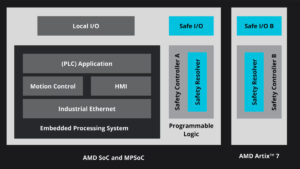
This stack supports platforms such as Linux, Windows, Ubuntu, and real-time operating systems (RTOS), helping developers build systems that combine safety, real-time performance, and flexibility for industrial and edge AI deployments.
Strong Industry Ecosystem Support
The expanded platform is already gaining support from major embedded computing providers, including Advantech, congatec, and Kontron, which are developing new systems based on the processors.
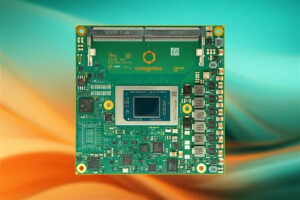
Advantech highlighted that the scalable architecture enables high-efficiency multitasking for next-generation edge AI solutions across Computer-on-Modules, single-board computers, and intelligent edge systems. Meanwhile, congatec emphasised the flexibility of the platform, which allows customers to tailor performance, power consumption, and cost for diverse edge workloads. Kontron also noted that the platform delivers powerful AI acceleration and compute performance in a compact footprint suitable for industrial and edge deployments.
Availability
Processors in the AMD Ryzen AI Embedded P100 Series with eight to 12 cores are currently sampling, with production shipments expected to begin in July 2026. Models with four to six cores are already sampling, with production scheduled to start in Q2 2026.