


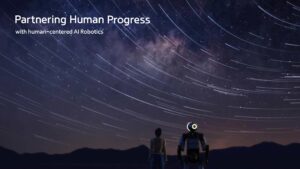
Hyundai Motor Group (the Group) today revealed its ambitious AI Robotics Strategy at CES 2026 in Las Vegas, outlining a bold roadmap to lead the next era of human-centred robotics. Under the theme “Partnering Human Progress,” the strategy reflects the Group’s vision for advancing human-robot collaboration through real-world deployment of intelligent, adaptive robots powered by artificial intelligence.
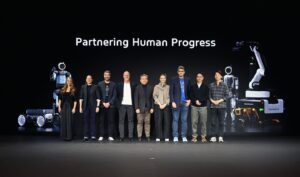
Building on its CES 2022 theme, “Expanding Human Reach,” Hyundai Motor Group is shifting from hardware-driven robotics to AI-powered systems designed to learn, adapt, and work safely alongside humans. At the core of this vision is the Group’s commitment to Physical AI; the integration of AI with real-world hardware to enable autonomous decision-making across robotics, smart factories, and future mobility.
Three Strategic Pillars Driving the AI Robotics Vision
Hyundai Motor Group’s AI Robotics Strategy is anchored by three foundational partnerships designed to unlock new industrial and societal value.
1. Partnering Humans with Co-Working Robots
The Group is ushering in a new era of human-centred AI Robotics, beginning in manufacturing environments. Robots will be deployed to handle hazardous, high-risk, and repetitive tasks, reducing physical strain on workers while enhancing safety and productivity. Humans remain fully in control, focusing on oversight, decision-making, and training robots for continuous improvement.
Boston Dynamics robots are already delivering measurable impact in industrial settings worldwide. Spot, the agile quadruped, is deployed in over 40 countries for inspection, monitoring, and data collection. Stretch, the warehouse automation robot, has unloaded over 20 million boxes globally since its 2023 launch, transforming labour-intensive logistics operations.
Atlas: The Next Generation of Industrial Humanoid Robotics
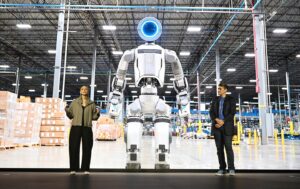
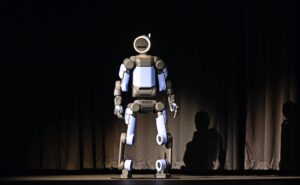
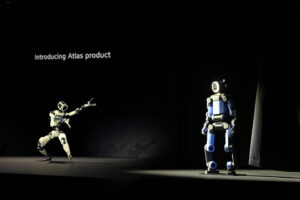
At CES 2026, Boston Dynamics unveiled the product version of Atlas, marking a major leap forward in humanoid robotics for industrial applications. Designed as a general-purpose humanoid, Atlas is engineered to operate safely, reliably, and predictably within existing facilities.
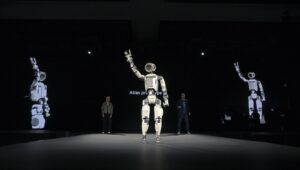
With 56 degrees of freedom, fully rotational joints, and human-scale hands with tactile sensing, Atlas is capable of performing demanding tasks such as material sequencing, assembly, and machine tending. It can lift to 110 lbs (50 kg), withstand harsh industrial conditions, and operate across a wide temperature range. Most tasks can be trained in under a day, significantly accelerating deployment timelines.
Atlas is designed for autonomy from day one, featuring self-sufficiency capabilities such as automatic battery replacement and continuous operation. Hyundai Motor Group expects humanoids to become the largest segment of the Physical AI market and has set a goal to mass-produce Atlas for large-scale industrial deployment.
Beginning in 2028, Atlas will be introduced at Hyundai Motor Group Metaplant America (HMGMA) in Georgia for validated sequencing tasks. By 2030, its role will expand to complex assembly and other labour-intensive processes, with gradual scaling across global production sites as safety and performance are proven.
2. Partnering the Group Value Network with Boston Dynamics
To acceleratecommercialisationn, Hyundai Motor Group is building a comprehensive End-to-End (E2E) AI Robotics Value Chain by combining Boston Dynamics’ robotics expertise with the Group’s global manufacturing scale, safety know-how, and diverse affiliate capabilities.
Key components of this ecosystem include:
● Software-Defined Factory (SDF):
A data-driven smart manufacturing platform that integrates real-world production data to improve robot learning, flexibility, and performance continuously. First introduced at the Hyundai Motor Group Innovation Centre Singapore, SDF has evolved into a next-generation platform now deployed at HMGMA, with plans for global expansion.
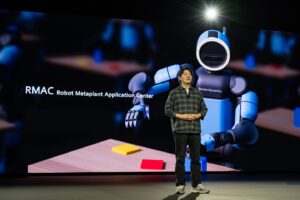
● Robot Metaplant Application Centre (RMAC):
Scheduled to open in the U.S. in 2026, RMAC will serve as the engine of the Group’s AI Robotics business. Robots will learn human-like movements and collaboration through precision training, combining simulated learning with real-world operational data to enable continuous improvement.
● Strategic Partnerships with NVIDIA:
Hyundai Motor Group is leveraging NVIDIA’s AI infrastructure, simulation tools, and frameworks to accelerate Physical AI development. This collaboration is further strengthened through a national partnership involving Korea’s Ministry of Science and ICT to advance global AI competitiveness.
Scaling Production and Robotics-as-a-Service (RaaS)
Hyundai Motor Group plans to establish a scalable production system capable of manufacturing 30,000 robot units annually by 2028. Affiliates across the Group play key roles:
● Hyundai Motor and Kia: Manufacturing infrastructure and large-scale production data
● Hyundai Mobis: Development and mass production of high-performance robotics components
● Hyundai Glovis: Optimised logistics and supply chain management
Beyond manufacturing, the Group is expanding Robotics-as-a-Service (RaaS) offerings, transforming robotics from a one-time purchase into a flexible subscription-based service. This model includes OTA software updates, maintenance, remote monitoring, and continuous performance optimisation. RaaS deployments with partners such as DHL, Nestlé, and Maersk demonstrate its scalability across logistics, energy, construction, and facility management.
3. Partnering with Global AI Leaders to Shape the Future
Extending beyond the Group Value Network, Boston Dynamics has entered a strategic partnership with Google DeepMind to accelerate the development of next-generation humanoid robots. By combining Boston Dynamics’ robotics leadership with DeepMind’s advanced AI foundation models, including Gemini Robotics, the collaboration aims to enable robots to perceive, reason, use tools, and interact naturally with humans.
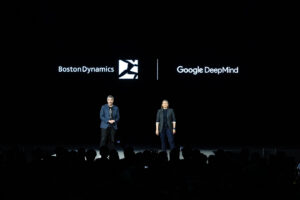
This partnership is expected to drive breakthroughs in safe, efficient, and scalable humanoid deployment, shaping the future of robotics and mobility worldwide.
Interactive AI Robotics at CES 2026
During CES 2026, visitors to Hyundai Motor Group’s CES 2026 booth were able to experience live demonstrations and immersive exhibits featuring:
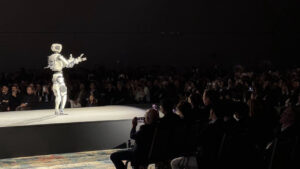
● Atlas, Spot, and Stretch in real-world industrial scenarios
● MobED, winner of the CES 2026 Best of Innovation Award
● IONIQ 5 Robotaxi, Automatic Charging Robot (ACR), and Parking Robot
● Collaborative solutions such as X-ble Shoulder, AMRs, Cobots, and logistics automation systems
The Group also premiered its official CES 2026 brand video, highlighting its vision for human-centred AI Robotics and the future of human-robot collaboration.
Through strategic partnerships, global manufacturing expertise, and a commitment to human-centred design, Hyundai Motor Group is positioning itself at the forefront of the Physical AI era, building a future where humans and robots work together to create safer, smarter, and more sustainable industries.
To learn more about Hyundai Motor Group and share its vision for robotics in the real world and metaverse under the theme ‘Expanding Human Reach’ to fulfil unlimited freedom of mobility, click here.