
It’s the holiday season, and I have packed my bags for my most anticipated trip of the year, the long-distance Europe trip. I’ll be hopping across seven cities in Europe, starting from Madrid and Barcelona in Spain, Lisbon in Portugal, Munich in Germany, Vienna in Austria, Lake Bled in Slovenia, and Venice and Milan in Italy.
No backup camera, no laptop most days, and no second phone. After 2.5 weeks of constant navigation, photography, video capture, translations, payments, and connectivity hopping between borders, the iPhone 17 didn’t just keep up but overperformed and proved why Apple’s latest upgrade is one of the most travel-friendly iPhones yet.
Display Made for Being Outdoors
Casa Milà – Barcelona, Spain
Travel often means harsh lighting, and this is where the new 6.3-inch Super Retina XDR display truly shines.

In Madrid’s midday sun and along the reflective canals of Venice, the iPhone 17’s 3000-nit peak outdoor brightness made maps, photos, and camera framing effortless.
ProMotion’s adaptive 120Hz refresh rate kept everything fluid, whether scrolling through transit schedules in Munich or flicking through images on a train between cities.
Jerónimos Monastery – Lisbon, Portugal
Ceramic Shield 2 deserves special mention. After weeks in and out of pockets, backpacks, and café tables, the screen remained impressively pristine.
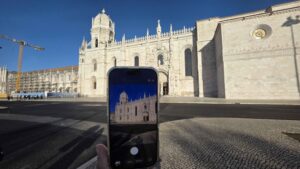
The improved anti-reflection coating also reduced glare noticeably when shooting or reviewing photos outdoors, which is a small but meaningful improvement when you’re constantly on the move.
Cameras That Adapt to Every City
Basilica De La Sagrada Familia – Barcelona, Spain
The iPhone 17’s all-48MP camera system feels purpose-built for travel.
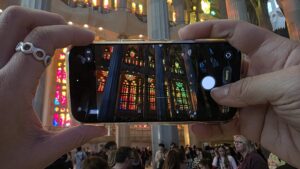

The 48MP Fusion Main camera delivered sharp, detailed shots of Gaudí’s architecture in Barcelona and the grand plazas of Vienna, while the optical-quality 2x Telephoto was perfect for street photography without stepping too close.
Lake Bled – Bled, Slovenia
The new 48MP Fusion Ultra Wide camera was a standout in places like Lake Bled.

Expansive landscapes benefit hugely from higher resolution and better edge detail.
Seafood Paella at Marina Ventura Restaurant – Madrid, Spain

Macro photography also felt more usable and less gimmicky for capturing textures, food, and small architectural details with surprising clarity.
Murano – Venice, Italy
Apple’s updated Photographic Styles made quick edits almost unnecessary.

The new Bright style, in particular, helped lift skin tones naturally during golden-hour portraits without overprocessing, something I appreciated when sharing photos straight to social platforms mid-trip.
Centre Stage Front Camera: Surprisingly Useful
The new Centre Stage front camera sounds like a “nice-to-have” feature until you’re actually travelling. Couple selfies in Venice and quick vlogs while walking through Milan all benefited from the wider field of view and intelligent framing.
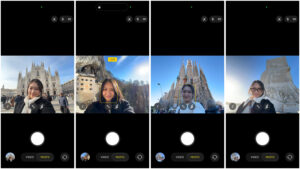
Being able to shoot landscape-style selfies while holding the phone vertically felt oddly liberating, especially when recording travel clips one-handed.
Video and Audio That Feel Professional
iPhone 17’s 4K60 Dolby Vision video continues Apple’s dominance in mobile video. Action-modified walking shots through busy streets, while Cinematic mode added polish to more deliberate clips. Spatial Audio, Audio Mix, and wind noise reduction made a real difference when recording outdoors, especially near the coast or in open plazas where wind can ruin otherwise great footage.
Dual Capture was another unexpected win, letting me record reactions and surroundings simultaneously, great for capturing moments without breaking the flow of travel. For anyone who travels and edits on the go, the ability to capture content that’s essentially “ready to publish” is invaluable, and the iPhone 17 delivers exactly that.
Performance and Battery That Don’t Get in the Way
Duomo Di Milano – Milan, Italy
Powered by the A19 chip, the iPhone 17 never once slowed down, whether juggling navigation, camera use, messaging, and music simultaneously, or handling photo edits and short video trims on trains between cities.
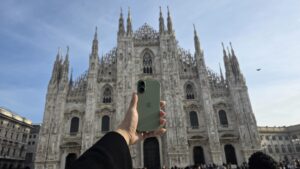
Gaming performance is impressive, but more importantly for travel, everyday tasks feel instant and efficient.
Basilica De La Sagrada Familia – Barcelona, Spain
Battery life was consistently reliable. Long days starting early and ending late still left enough charge for photos, maps, and evening browsing.

Apple’s claim of up to 30 hours of video playback feels believable in real-world use, and fast charging with up to 50 per cent in 20 minutes was a lifesaver during short café stops.
Seamless Connectivity Across Borders
Schönbrunn Palace – Vienna, Austria
Travelling across multiple countries highlighted how valuable eSIM has become. Switching between international roaming plans and local options was painless, and iOS 26’s streamlined eSIM setup made it even easier.

Combined with the new N1 wireless chip enabling Wi-Fi 7 and Bluetooth 6, connectivity felt stable and fast throughout the trip, whether using Personal Hotspot or AirDrop.

With the inclusion of Search on Google, translations of Menus, maps and email bookings were quick, making the iPhone more of a well-rounded travel companion. In this screenshot collage, I was buying the Airport transfer bus back to Milan Airport from Milan Centrale.
Belvedere Palace – Vienna, Austria
After weeks of real-world travel across Europe, the iPhone 17 proved to be more than just a yearly upgrade. It’s a genuinely dependable travel companion: one that handles photography, video, navigation, communication, and entertainment without demanding attention or compromise.

For travellers, content creators, or anyone who wants a phone that simply works wherever you are, the iPhone 17 feels like Apple refining its formula in all the right ways.
For more information on iPhone 17, click here.